MYLODLibrary is a bibliographic catalogue that describes resources not as isolated, self-contained records, but as a network of entities related to one another according to the logic of Linked Open Data, the IFLA LRM conceptual model and the RDA cataloguing standard.
The underlying premise is that a catalogue should not merely attest that a document exists, but should make explicit the relationships that run through it: the link between a work and its translations, between an edition and the copy held, between an author and the body of their writings, between a text and the themes it addresses, and much more besides. A traditional bibliographic description states these relationships in a discursive, closed form, intelligible to a human reader but opaque to any automated processing; here they are instead encoded in a formal structure, and therefore queryable, verifiable and reusable by third-party systems.
The project integrates two cataloguing paths — the traditional library format, MARC21, and native description in IFLA LRM — which converge in the same public catalogue and feed a single RDF data graph, freely queryable, including through a SPARQL endpoint. The sections below retrace its main components, from the discovery interface through to the tools for producing and publishing the data.
A note for readers: the resources held in the MYLODLibrary catalogue belong to a private, personal book collection that is constantly being updated, published with the purpose of being made available for study and for the development of the project. For this reason it is important to note that, at the level of Item description, the data are intended only to validate MYLOD research and output and to provide study material for data entry and for building the Linked Open Data.
Search and explore
The general catalogue is the gateway to the holdings described in MYLODLibrary and the primary vantage point for anyone consulting it. Queries can be run in simple form — by title, author or subject, with wildcard support for partial searches — or in advanced form, combining multiple criteria through boolean operators (AND, OR, NOT) that make it possible to narrow the result set progressively until exactly what is needed has been isolated.
The discovery interface offers an analytical rendering of context: alongside the list of results, a panel of dynamically computed statistics describes the portion of the catalogue being consulted, broken down by language of the text, place and date of publication, agents and so on. The option to filter results by mode of registration gives users an overview of what has been published in native RDF format or, where applicable, starting from MARC21. Searching thus ceases to be mere record retrieval and becomes an analytical instrument: the user obtains not just a list, but a quantitative summary of the subset they have isolated.
Each result also declares its own provenance by reporting the total number of triples generated, making the informational density behind the description immediately perceptible. From here one reaches the complete record of the work and all the formats in which it is available.
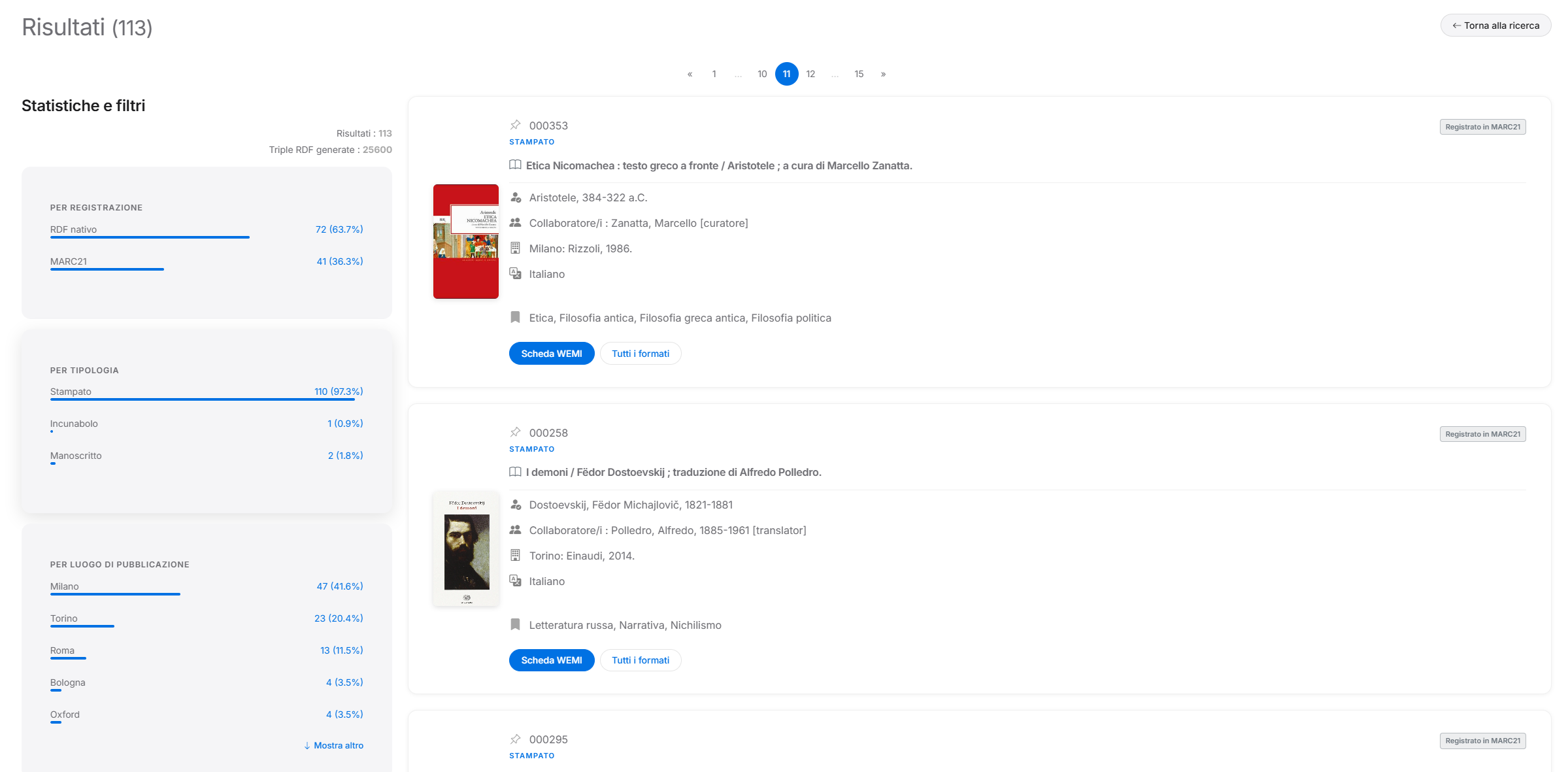
Searching the general catalogue, with filters and real-time statistics
Work, Expression, Manifestation, Item
At the heart of the project's conceptual framework lies the IFLA Library Reference Model, the reference framework through which the international library community has rethought the description of resources. The principle is that what we commonly call "a book" is not in fact a single object, but the superimposition of four distinct, hierarchically linked entities.
The Work is the intellectual content in the abstract — the Divine Comedy as a creation of the mind, regardless of how one reads it. The Expression is a concrete realisation of it: a particular translation, a critical revision, a version in a given language. The Manifestation corresponds to the edition as physically produced and published, with its publisher, its year, its ISBN. The Item, finally, is the single copy physically held and shelved.
Describing these four levels separately, rather than compressing them into a single record, allows the catalogue to answer questions a flat description cannot even formulate: how many translations of a given work exist, in which editions they were published, which copies are held. Each entity is furthermore related to the agents that produced it, the subjects it treats, and the places and periods it refers to.
The entire web of these relationships can be inspected as an interactive graph, generated automatically from each record: a tool that makes visible — and pedagogically legible — the semantic architecture underpinning bibliographic description. This scheme also serves the software system that produces the data, since it allows the machine to generate, manage and preserve automatically every relationship the cataloguer is able to describe, thereby giving those who consult the catalogue the freedom to move across the various scenarios that the resources encompass or can lead to, both within the catalogue and beyond it.
The same relational logic extends to agents themselves: a person can be declared a member of a corporate body, a corporate body can precede or succeed another — through mergers, splits, name changes — and two agents can more generally be recorded as associated. These links too, modelled on the relation types defined by IFLA LRM, are published as RDF triples and shown on each agent's public record.
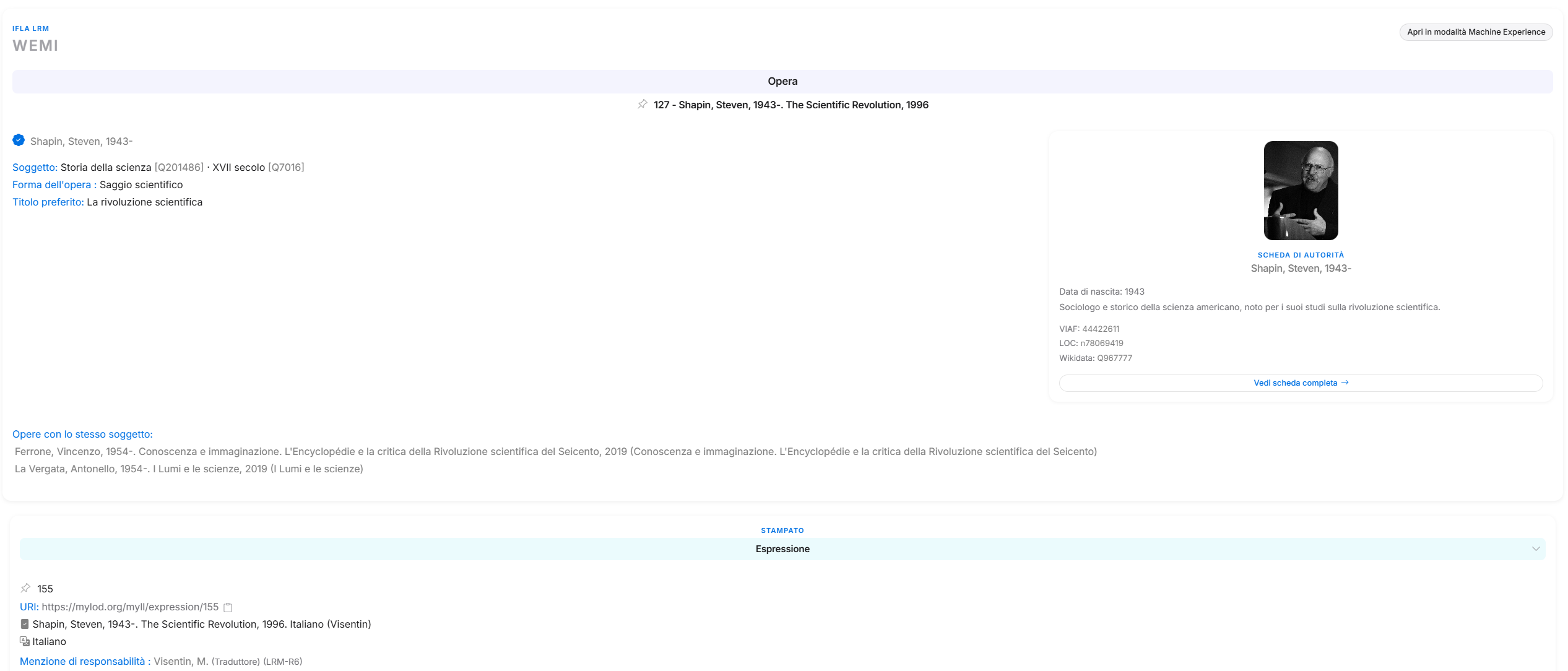
The Work → Expression → Manifestation cascade, with the agent's authority record alongside
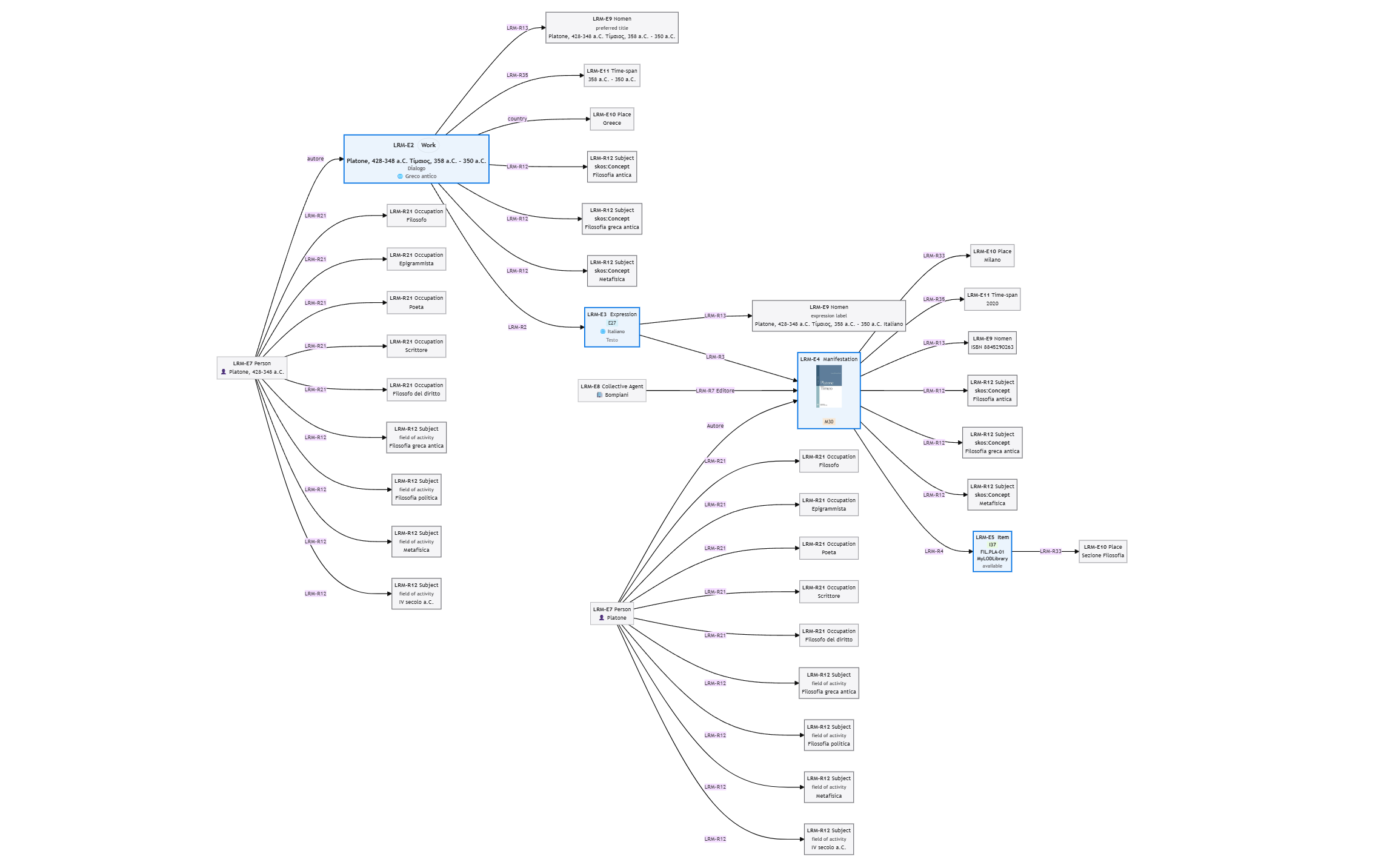
The LRM relationship graph, generated automatically for every work
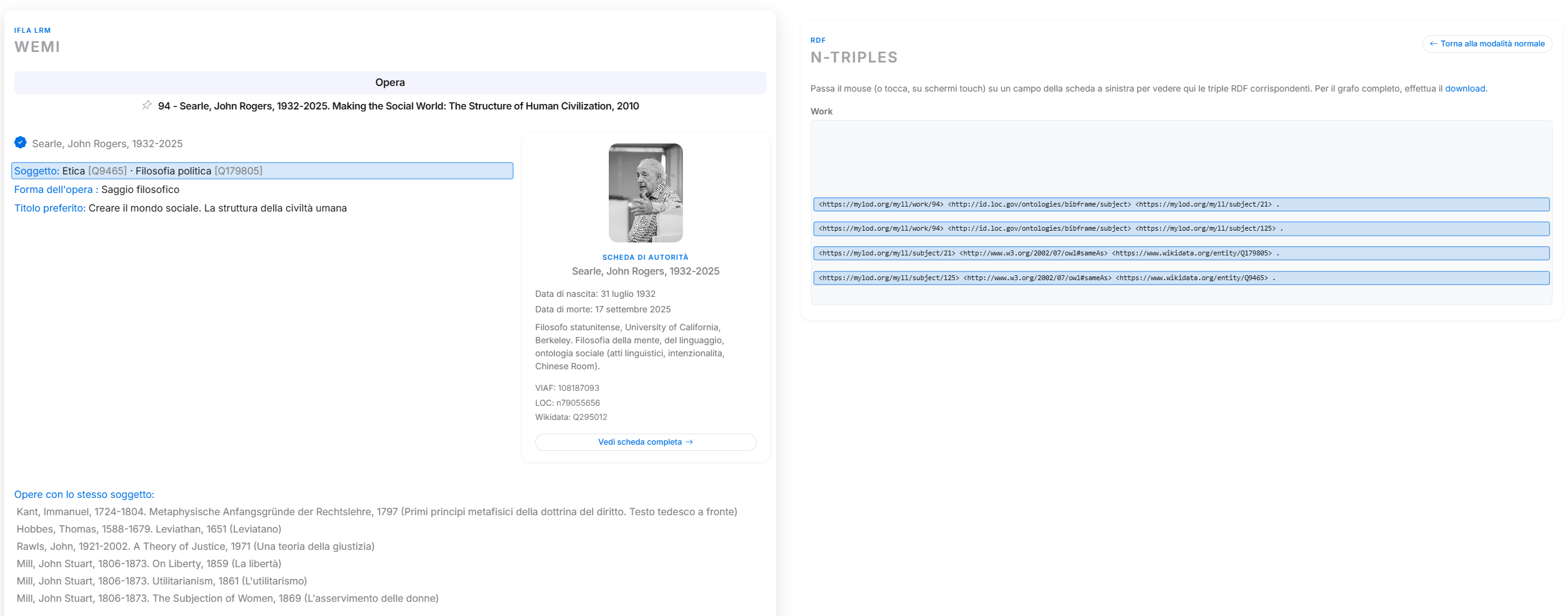
Let natural language and machine language live side by side, exploring your RDF triples
Agents, places and subjects as entities
Authors, corporate bodies, places, subjects, occupations and uniform titles do not appear in the catalogue as text strings replicated in every record, but as autonomous authority entities: described once, given their own persistent identifier and called by reference wherever they occur. This is the principle of authority control, applied here systematically to every class of entity provided for by the model.
Concrete consequences follow. A correction to the form of an author's name propagates instantly to every work that references it, with no need for repeated intervention; name variants, pseudonyms and forms in different scripts converge on the same entity, ensuring that a search on any one of them still leads to the same result.
Each authority record gathers the preferred form of the name, the recorded variant forms, a biographical or descriptive note and — decisively for interoperability — links to the identifiers of the main international agencies: VIAF, Library of Congress, ISNI, Bibliothèque nationale de France, SBN and Wikidata, to name a few. Through these alignments the entity ceases to be local data and takes its place in the global network of bibliographic authorities, where biographical and geographical data can be enriched automatically from the linked sources.
Every description can finally be exported in the main RDF formats — Turtle, JSON-LD, N-Triples, RDF/XML, N-Quads — or explored directly in a graph query environment.
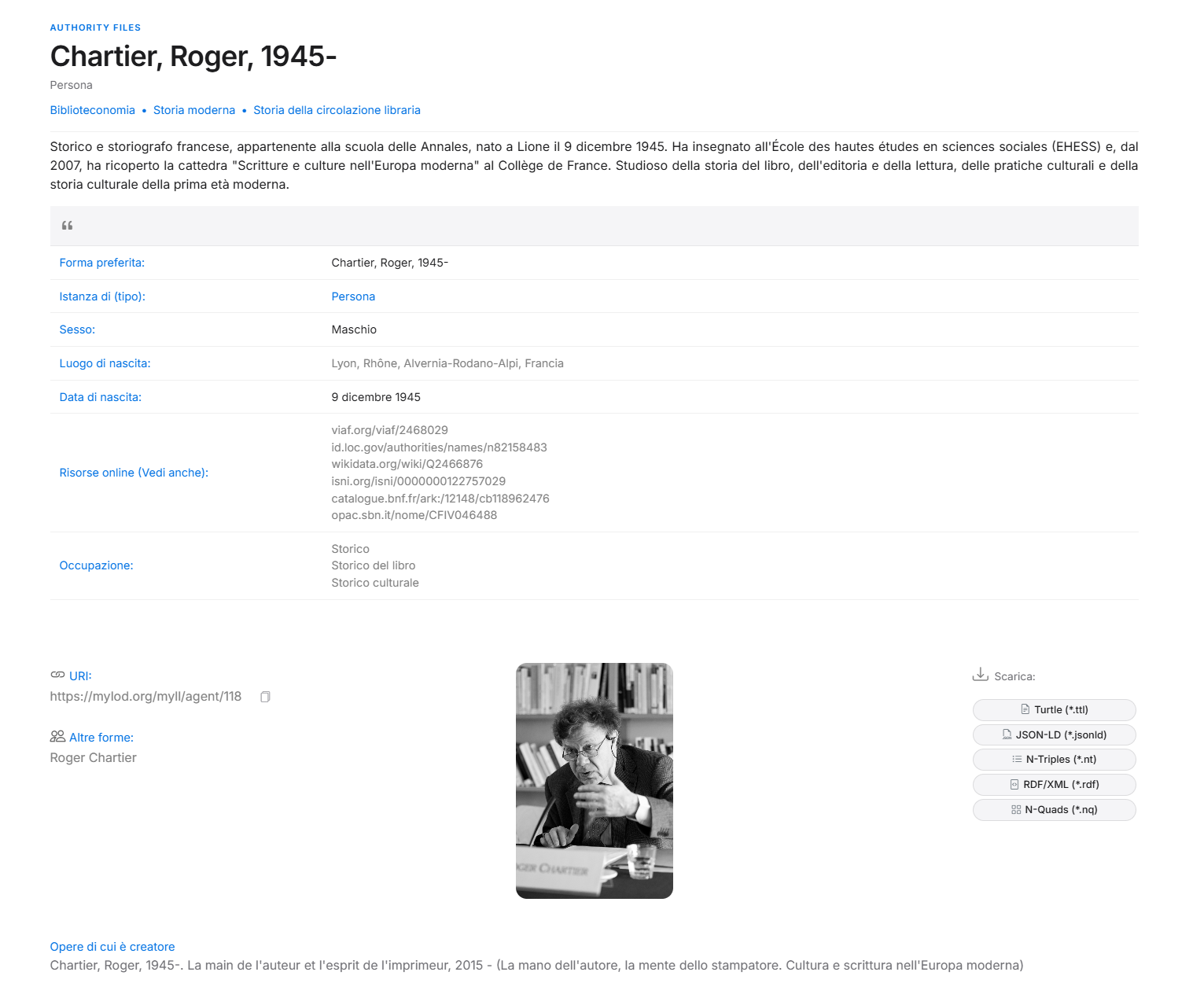
Authority record with RDF export, enriched automatically from Wikidata
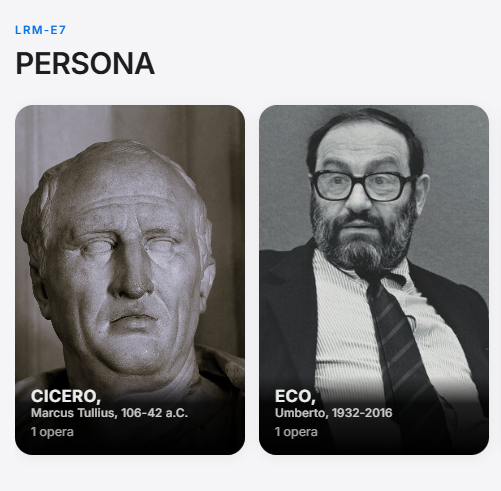
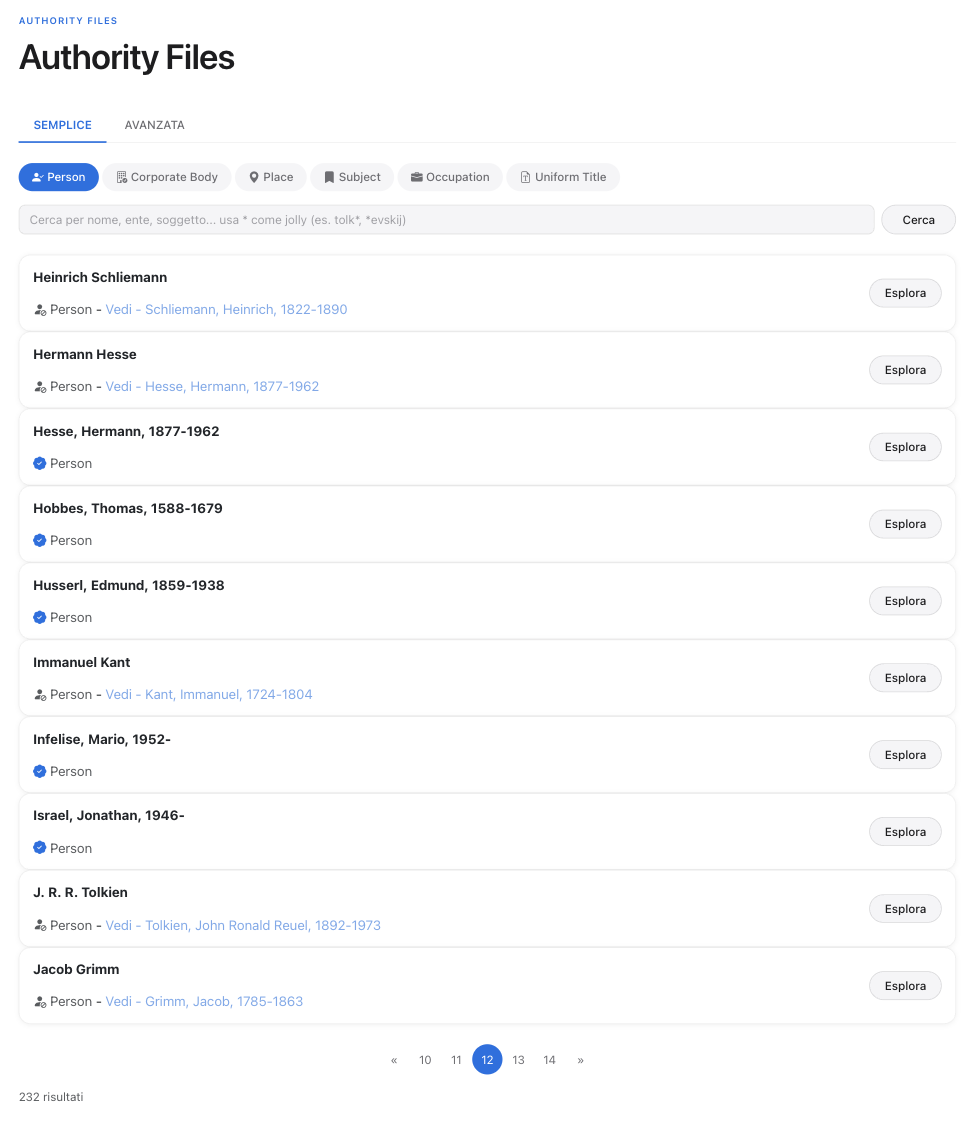
Persons as autonomous entities, and the dedicated search by entity type
A queryable data graph
Every entity described in the catalogue — works, expressions, manifestations, copies, agents, places, subjects and periods — is at the same time published as a set of RDF triples, the elementary unit of the semantic web, each made up of a subject, a predicate and an object. The properties used are not defined locally but drawn from the standard vocabularies adopted by the international community: BIBFRAME, FOAF, and many others.
This structure is what allows the data to leave the boundaries of the application. An external system that knows those vocabularies can interpret MYLODLibrary's descriptions with no prior agreement, just as the catalogue can in turn attach itself to external resources through shared identifiers. The result is not a closed archive, but a node within a wider documentary network. The conversion of the data from the MARC21 format to RDF (through various stages of production as well as of available data format, such as MARCXML) is designed to give the cataloguer the possibility of learning the semantics of RDF data without leaving the MARC21 format. This is made possible by the parallel coexistence of two databases: the relational one, on which MARC21 operates, and the open one, built to hold data published for the semantic web.
The entire graph of triples is publicly queryable in SPARQL, the native language for exploring RDF data, through a read-only endpoint. To lower the barrier to entry and make searching easier, the interface offers a collection of ready-made queries — the distribution of languages, the authors active in a given century, the most recurrent subjects — that can be run immediately and then modified: a way of learning the language by observing its effects, with no prior expertise.
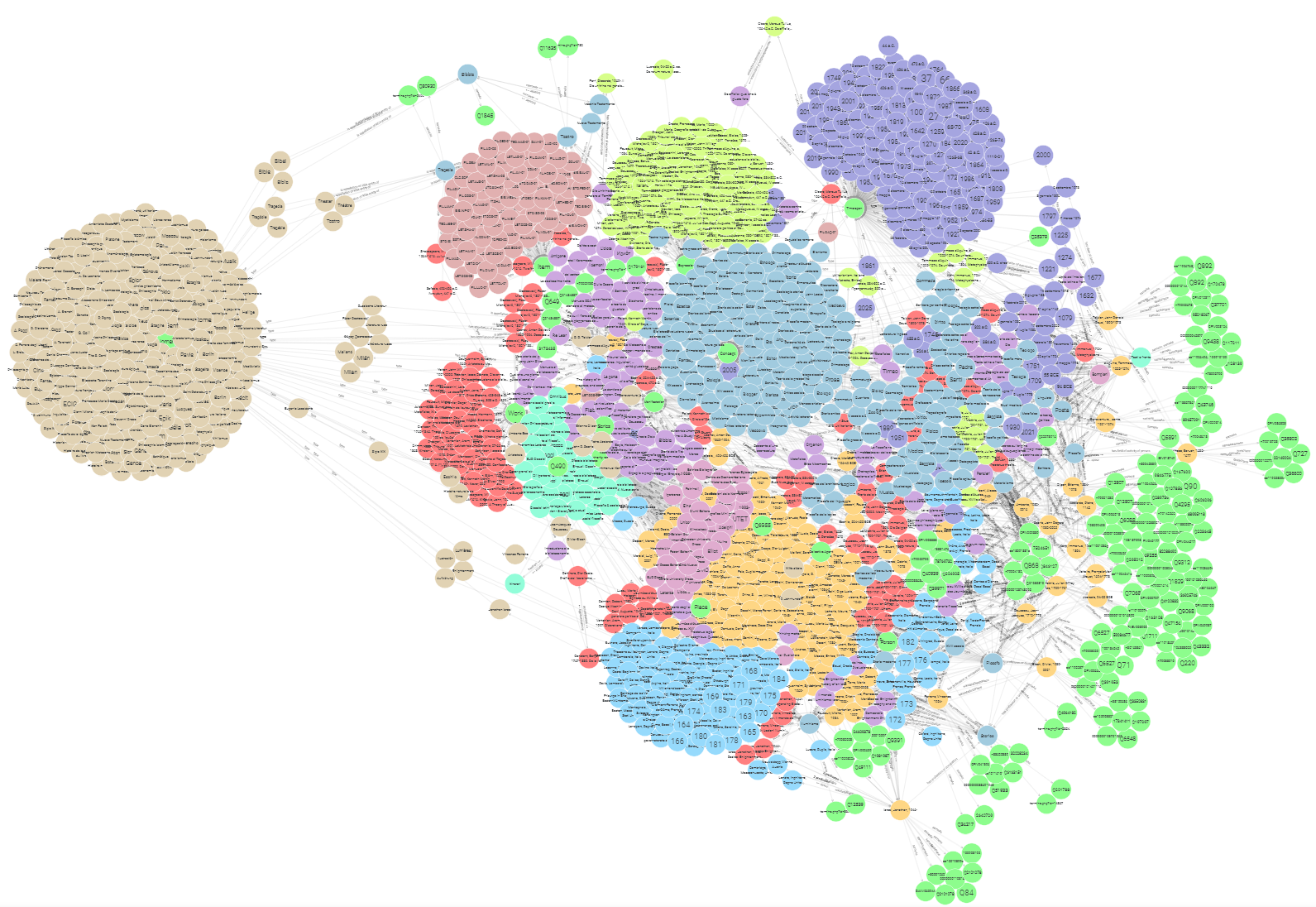
A portion of the catalogue's RDF graph: each node is an entity, each edge a relationship
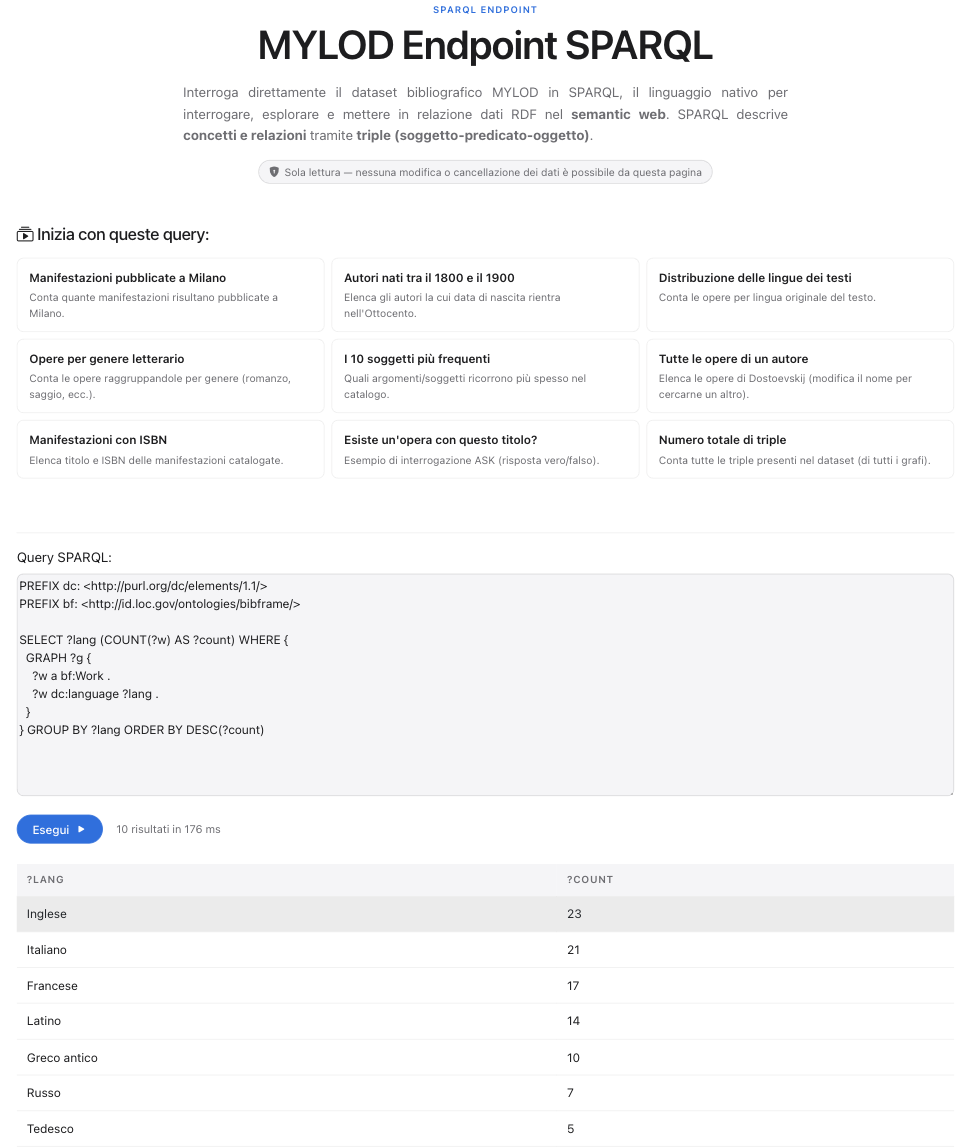
The public SPARQL endpoint, with ready-to-use example queries
MARC21, native RDF and your personal space
On the data production side, MYLODLibrary follows two parallel routes rather than imposing a single one. The first starts from the traditional library format: a MARC21 record is compiled according to established practice, and an automated procedure derives from it, field by field, the corresponding LRM entities, generating the Work-Expression-Manifestation-Item chain and the related authority links. The second allows direct native cataloguing according to the RDA and IFLA LRM models, through a suite of forms dedicated to each entity in the model.
The two routes are not alternatives to each other but answers to different needs: the first safeguards the training investment and workflows of those already working in MARC21, the second makes it possible to exploit the expressiveness of the LRM model without the constraints of a format conceived in another technological era. Both converge in the same catalogue and the same RDF graph. This means that each entity meets cataloguing requirements regardless of the format chosen. Whether producing native RDF or starting from MARC21, one still arrives at the cascading publication of the WEMI system.
Every registered user is furthermore given a personal cataloguing space — a laboratory in which to practise and build their own descriptions, starting from scratch or from a pre-filled sample record. Data worked on in this area remains strictly private: it does not appear in the public catalogue, is not visible to other users and does not enter the queryable graph. This is an essential condition if the tool is to be used in teaching contexts too, where error — and, where applicable, the reporting of platform maintenance issues — is part of the process of growth and learning.
The personal space is not, however, sealed off from the rest of the catalogue: a cataloguer is free to reuse authority entities that are already public — an agent, a place, a subject, an occupation — exactly as an experienced cataloguer would, avoiding needless duplication. Expressions, Manifestations and Items, by contrast, always remain one's own distinct entities: even when they describe a work already present in the general catalogue, they are never merged or overlaid onto existing records. The distinction is deliberate: authorities are shared heritage, detailed bibliographic description remains personal.
The descriptive model is not limited to the printed book: manuscripts and rare books have dedicated sections — support, gathering structure, script, binding, impression, printer's device — and, for manuscripts, a TEI/XML transcription module that can be generated automatically from the metadata already catalogued, or imported from a file produced elsewhere and validated against the official TEI schema. Rounding out the picture, every Manifestation can host its own digital copy — a PDF uploaded directly to the platform, viewable from the public record with no external software required.
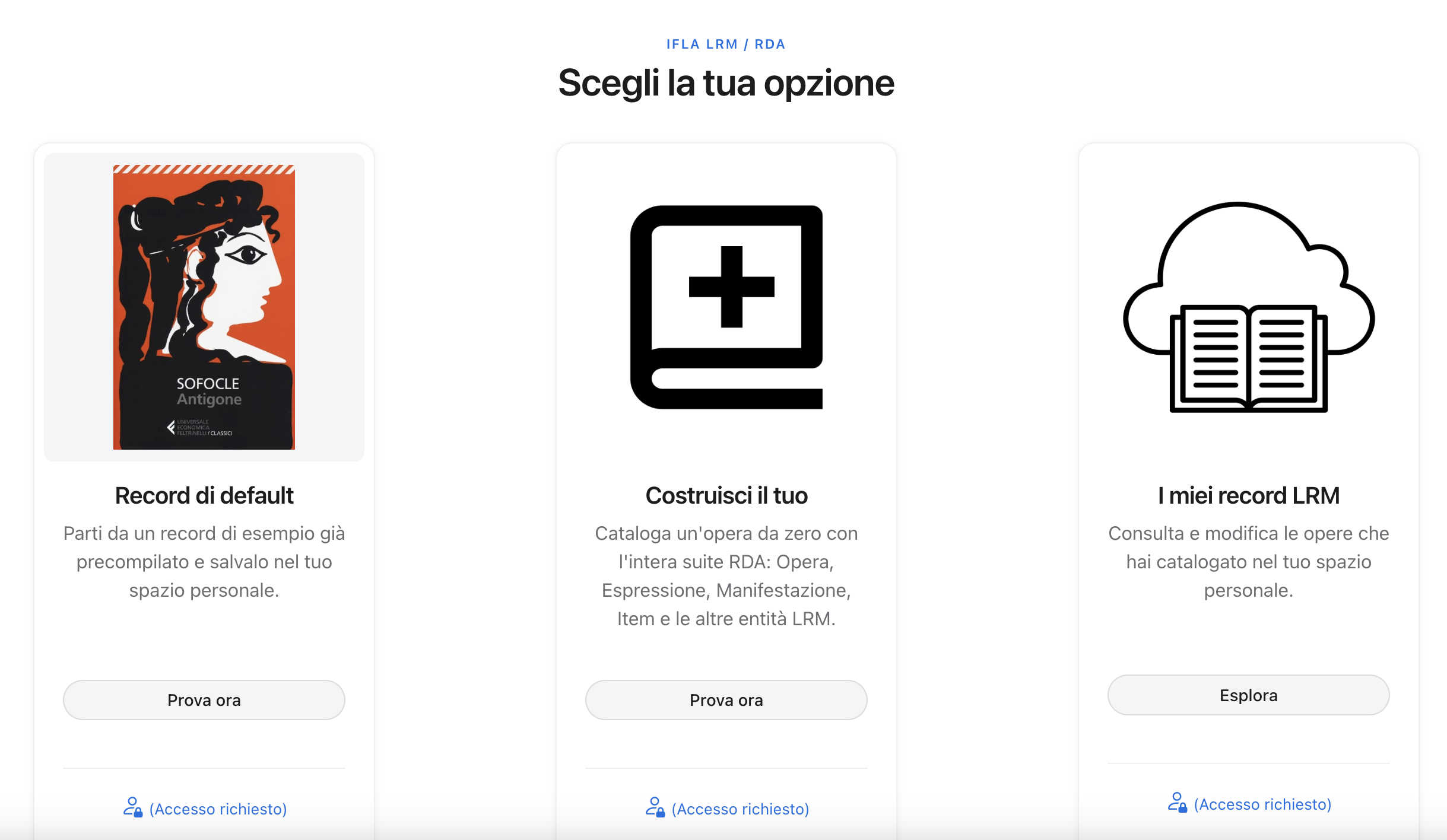
The native IFLA LRM/RDA cataloguing hub, with the cataloguer's personal space
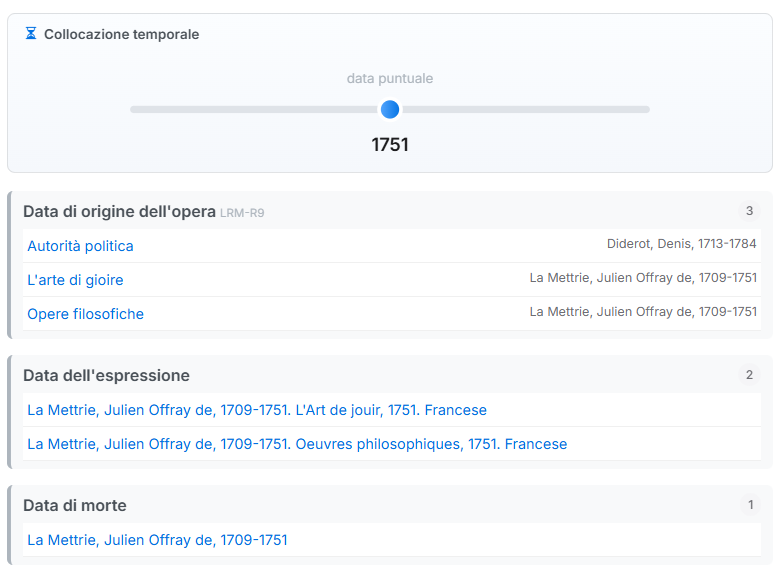
Navigate the relationships between resources through the Time-span entity